🚨 “THIS WASN’T AN APOLOGY…” In the case of Tanner Horner and Athena Strand, a jailhouse letter meant to explain only made things worse. 😳 Instead of remorse, his words sparked anger across the courtroom. 💔 A moment that left the victim’s family devastated. 💬 What did he say that changed everything?

Tanner Horner’s jailhouse letters, including apology to Athena Strand’s family, read in court during sentencing phase
Tanner Horner’s sentencing phase continued into its fifth day on Monday, nearly a week after he pleaded guilty to killing Athena Strand in rural Wise County in 2022. During Monday’s proceeding, letters that Horner had written in jail prior to a suicide attempt — including one meant for Athena’s family — were shown and read in court.
On Monday, the prosecution spoke with Sgt. Brett Yaro to resume questions about an incident in the Wise County jail, specifically about the letters. Yaro said he visited Horner’s cell after Horner was taken to the hospital and started pH๏τographing the scene before taking the handwritten letters as evidence.
Yaro said Horner had left the letters laid out on a bench in the cell. One envelope was addressed to “Athena’s Family,” another was addressed to “Detectives ONLY!!!” and yet another was addressed to Legacy Church in Springtown, located in Parker County. Another envelope was addressed to two people living in Fort Worth, while one more was addressed to someone living in Burleson.
The prosecution chose to read two of those letters on Monday: the one addressed to the Strand family and the one addressed to detectives.
What the letter to Athena Strand’s family said
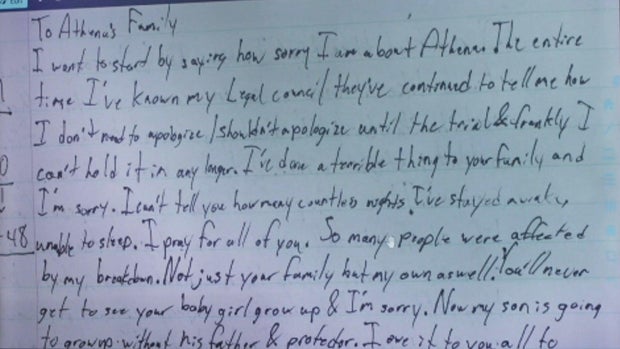
Horner’s two-page letter to the Strand family, which was read aloud by the prosecution, opened up with him saying: “I want to start by saying how sorry I am about Athena.” Horner went on to say that his legal counsel advised him against apologizing until the trial, but that he “couldn’t hold it in any longer.”
“I’ve done a terrible thing to your family and I’m sorry,” the letter continued. “I can’t tell you how many countless nights I’ve stayed awake, unable to sleep. I pray for all of you. So many people were affected by my breakdown. Not just your family but my own as well. You’ll never get to see your baby girl grow up and I’m sorry. Now my son is going to grow up without his father and protector.”
In his letter, Horner went on to say he lives with Asperger’s syndrome and doesn’t do well with changes that are “unpredictable in nature.” He also said that when he began working as a FedEx driver, he was given a singular route that didn’t change for a while. However, Horner said his employer, who was not identified in the letter, began “making random changes” to his route “so they could make more money.” He emphasized again that he didn’t adjust to change well and said that changes one day almost sent him into a suicidal episode.
“The only thing that stopped me was thinking of my son growing up without his father,” he wrote, adding that he took a week off from work to get help and was later put on medication.
What Horner said happened next
Horner said that while he told his employer that he needed a consistent route, he said in his letter that he was ignored. Instead, Horner said his employer made him a “floater,” placing him on a different route every day. He said that only caused his mental health to worsen, and he couldn’t quit because he had to provide for his son.
Horner, in his letter, theorized that his employer “got sick of me constantly telling them I needed consistency” and then “sold me off to another company without me having any say in the matter.” He also theorized that his employer was trying to get him to quit.
The letter goes on to say that Horner’s life “started to kind of fall back into place.” He was now working with Big Topspin, whom he did identify in the letter to the Strand family, and he had a car again. However, he still faced minor meltdowns because, he claimed, Big Topspin “still refused to put me on a consistent route.”
Horner also said Big Topspin forced employees to work six-day workweeks as the holiday season approached and as delivery volume increased.
“It was all the wrong place and wrong time,” he wrote.
One more apology
The conclusion of Horner’s letter began with more apologies to the Strand family.
“I’m sorry I allowed my mental state to be unstable. I’m sorry I took your little angel away from you. She didn’t deserve it. Y’all didn’t deserve it,” he wrote. “My son didn’t deserve to lose his father. My mother didn’t deserve to lose her son. My fiancé didn’t deserve to have her wedding day stripped away from her.”
Toward the end, Horner wrote that he hoped his death would ease the Strand family’s suffering in some way.
“The only thing I ask is for forgiveness and for you to remember my son and show him some grace and mercy,” Horner wrote, “for he no longer has his father. I love you all and I’m sorry.”
The letter to detectives
The prosecution went on to read Horner’s letter to detectives, which was one page in length. He noted that he wrote this letter two days before his arraignment date and that he was worried he’d be killed either en route to court or on the way back from it.
In this letter, Horner claimed that the day Athena was killed, he “wasn’t the only one involved.” He claimed that when he arrived at the Strand property, an older man had “pulled a rifle” on him and demanded his wallet. Horner claimed the man returned his wallet to him and told him to take Athena and bring her elsewhere, to the area with bamboo he first led investigators to during the search for the girl.
Horner claimed this man gave him a change of clothes for Athena and told him to have her change into them before handing her over to him. Horner claimed this man threatened his family and that he didn’t know what else to do but go along with it. He also asked detectives not to tell the media and that he was still unsure if this man would “do something.”
“If I’m killed on the way to or from the courthouse,” Horner continued, “I’ll ᴀssume it was him.”
Horner claimed that when he handed Athena over to the stranger, she calmed down after seeing the man and was familiar with him. He also claimed that he shut his vehicle’s headlights off and followed the pair to the creek. Horner also said, in his letter, that he saw Athena’s body the next day and put her in the water.
Toward the end of this letter, Horner insisted that detectives not share this information with media outlets or his family. He also asked that the information not be shared with the Strand family “until after their lawsuit against FedEx goes through.”
“This is between me and you, detective,” he added. “As long as it stays between us, my family stays safe. I’ll gladly keep the blame as long as they’re safe.”
In the letter, Horner provided a physical description of the man. He also claimed the man asked about the FedEx truck’s cameras three times, and asked that detectives “keep it from everybody” when they find him.
After both letters were read, the prosecution asked Yaro more about them. Yaro affirmed that while Horner took responsibility for Strand’s death in the letter addressed to the family, Horner instead placed the blame on the man he described in the letter to detectives.
The prosecution continued to verify with Yaro further evidence collected at the time of Horner’s arrest, which chiefly involved the clothes collected from him at the jail. The defense also submitted further exhibits, and Yaro was excused from the witness stand, subject to future recall.
Horner’s phone calls to family
Jurors also heard phone calls Horner made to his family members.
As Horner said in court with his head in his hands, audio played from a phone call with his mother.
“What did you do? Did she die on her own?” his mother is heard saying.
“No,” Horner replied.
“Oh my God,” his mother said.
“I know,” said Horner.
Horner then went on to ask about bail and his son.
✓ max
Tanner Horner’s jailhouse letters, including apology to Athena Strand’s family, read in court during sentencing phase Tanner Horner’s sentencing phase continued into its fifth day on Monday,…